
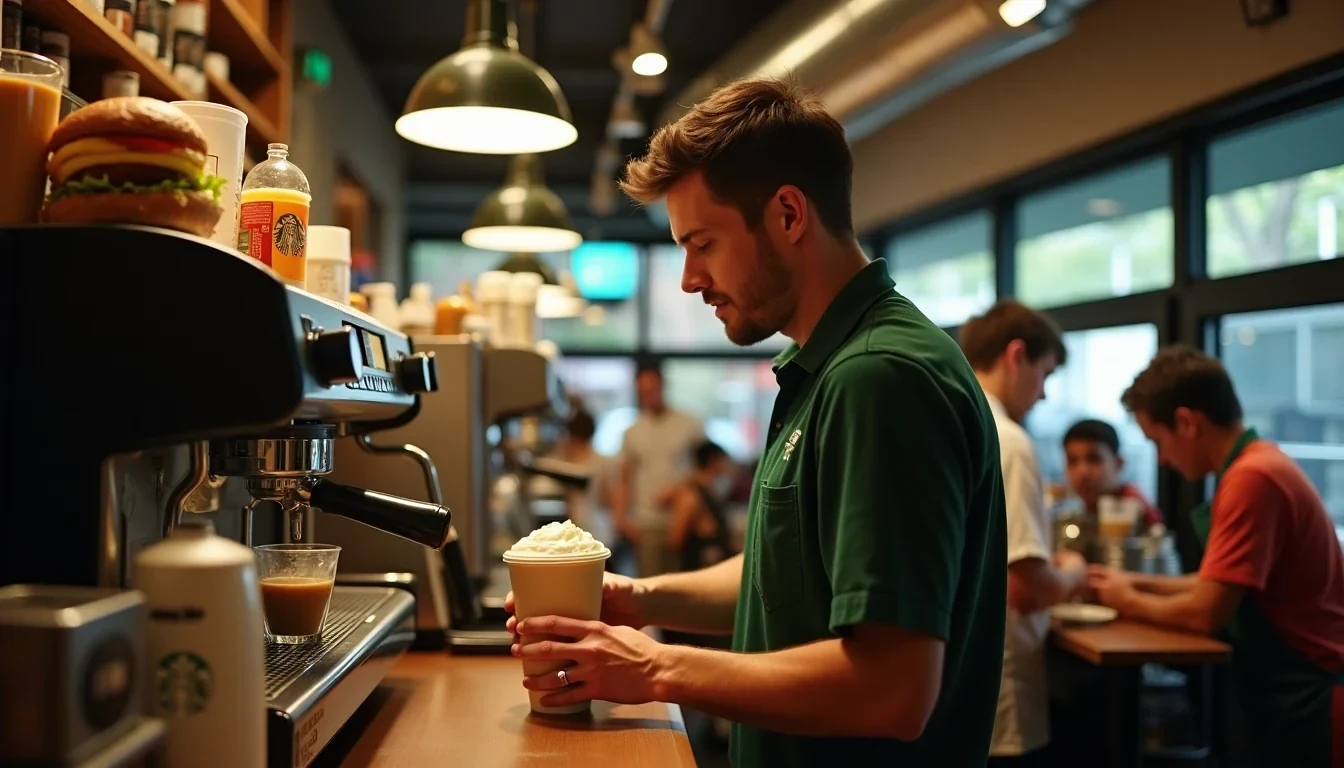
Starbucks proved that the fastest way to kill a coffee shop is to stop selling coffee. By the mid-2000s, the chain had become a food-service labyrinth disguised as a café: breakfast sandwiches, smoothies, Frappuccino permutations, and enough milk alternatives to stock a small dairy. The menu kept growing. The operating margin kept shrinking. Customers, increasingly, kept walking.
What Starbucks Actually Built
The company Howard Schultz returned to in 2008 was operationally unrecognisable from the espresso-bar concept he had originally scaled. Stores carried sandwiches requiring ovens, blenders for frozen drinks, and inventory for dozens of syrup flavours and toppings. Baristas faced effectively infinite drink combinations. Each new item demanded training time, storage space, equipment maintenance, and seconds in the preparation queue that compounded across hundreds of transactions per day.
This was not merely aesthetic drift; the operational architecture had changed. A store designed around espresso extraction and rapid handoff had become a general-purpose quick-service kitchen. The Mastrena espresso machine, introduced in 2008, was partly a response to this: a faster, more automated unit that could recover some throughput lost to the menu’s expansion. Equipment alone could not compensate for systemic complexity. Training costs rose because onboarding now required mastery of food preparation, not just coffee. Inventory waste climbed as perishable ingredients for low-velocity items expired. Error rates multiplied with customization options, producing remakes that consumed labour and materials while extending wait times for every customer in line.
The financial mechanism is straightforward once you look past revenue to margin. Each additional menu item generates incremental sales from the small subset of customers who want it. Against that revenue, the business must charge the full cost of carrying the item: procurement, storage, spoilage, training, the slower service that reduces peak-hour throughput, and the errors that cascade from complexity. Starbucks had reached the point where marginal revenue from menu expansion fell below marginal cost. The growth strategy had become self-liquidating.
The Turnaround Mechanism
Schultz’s “Back to Starbucks” plan, launched in 2008, treated complexity as a line item to be cut, not a regrettable side effect. The company pruned slow-selling food items, reduced Frappuccino variants, and refocused the menu on core coffee offerings. Customization remained available but was streamlined around options that did not degrade preparation speed. Store layouts were reconfigured to reduce bottlenecks. Training was redirected toward espresso craftsmanship and efficient workflow rather than breadth of menu coverage.
The equipment investment continued, with the Mastrena II rollout emphasising reliability and speed at the core operation rather than capacity for peripheral products. The “third place” concept, the comfortable environment between home and work, was reaffirmed as a design priority rather than sacrificed to kitchen equipment and queue management.
This was subtraction as strategy, not retrenchment. The typical owner response to slowing sales is to add: new flavours, new formats, new dayparts, new price tiers. Starbucks had followed this path to its logical conclusion and found that more offers produced worse economics. The turnaround inverted the reflex. The question was not “what else can we sell?” but “what are we selling that costs more than it returns?”
The Numbers That Resulted
The financial recovery was measurable and sustained. By July 2026, Starbucks had recorded four consecutive quarters of comparable-store sales growth and raised its annual forecast. Quarterly operating margin improved from 10.1% to 14.4%, a 430 basis point expansion that reflects genuine operational leverage rather than accounting adjustments.
That margin recovery is the critical figure. Revenue growth through menu expansion would have shown in top-line numbers without necessarily improving profitability. The operating margin gain demonstrates that costs fell faster than revenue from eliminated items, and that throughput improvements from faster service converted into actual sales volume. A store serving more customers per hour with the same staffing level spreads fixed labour costs across more transactions. Reduced error rates cut waste. Simpler inventory management lowered working capital requirements and spoilage.
The mechanism is general. Complexity in retail operations functions as a regressive tax. It falls heaviest during peak hours, when the business is most profitable and customers are least tolerant of delay. It accumulates invisibly because no single menu item appears costly in isolation. Only the aggregate burden becomes visible in eroded margins and declining customer satisfaction.
What Was Knowable at the Time
The pre-turnaround data was available to any analyst who looked. Comparable-store transaction growth had decelerated while menu items proliferated. Customer satisfaction surveys flagged wait times. Employee turnover in a tight labour market signalled operational stress. The case for complexity reduction did not require foresight; it required willingness to accept lower nominal revenue for higher quality revenue.
Schultz’s advantage was not information but authority. A returning founder could override the growth mythology that equates menu breadth with customer responsiveness. The harder judgment is recognising when subtraction is appropriate without the legitimising narrative of a founder’s return. For operators without that platform, the discipline is institutional: tracking contribution margin by item, measuring the operational cost of customization, and accepting the revenue loss from deliberate pruning.
The Unresolved Question
Starbucks demonstrated that operational complexity can be reversed and that the reversal produces financial returns. What remains unclear is whether the discipline can be maintained across successive management cycles. The pressure to grow revenue is constant and structurally rewarded by equity markets. Menu innovation is easier to communicate than operational refinement. The cycle that produced the pre-2008 bloat could recur under pressure to show top-line acceleration.
For operators in any retail or service business, the case raises a specific test. When sales slow, the default response is to add variety, promotions, or service extensions. The Starbucks turnaround asks whether the correct response is instead to audit the existing operation for accumulated complexity that has become a drag on core performance. The margin improvement from 10.1% to 14.4% suggests that for businesses that have grown through accretion rather than focus, the returns to subtraction may exceed the returns to expansion. The harder problem is building the organisational willingness to find out.